
Samui airport is being rebuilt for three times the traffic. What that does to property.
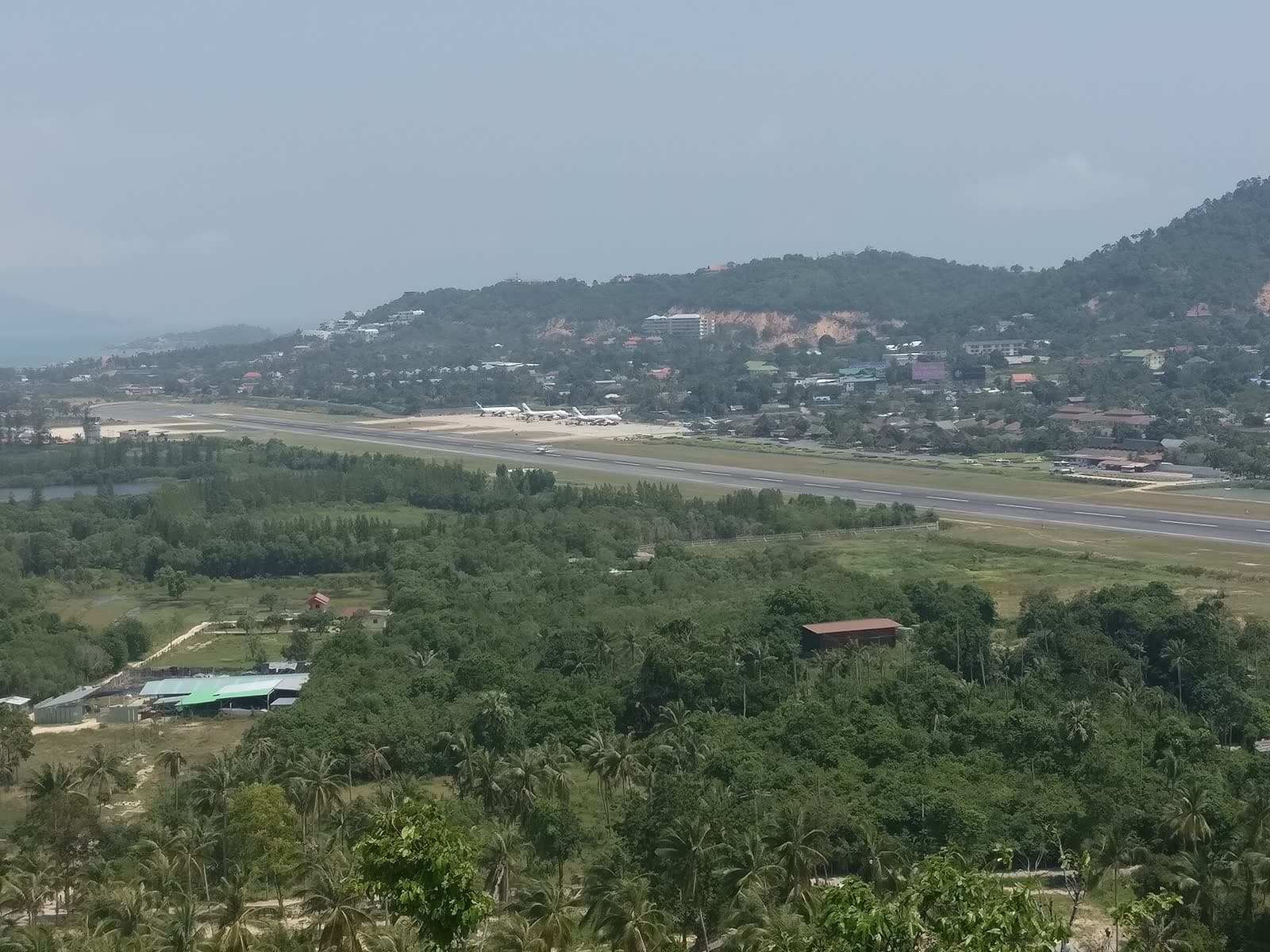
Image: Elmschrat — CC BY-SA 4.0, via Wikimedia Commons
Samui airport is being rebuilt to handle about three times the passengers it does today. Bangkok Airways, which owns and operates it, is committing roughly ฿1.5 billion to a terminal upgrade starting in 2026, lifting annual capacity from around 2 million passengers towards a stated target of 6 million. For anyone buying property here, that is the single most consequential number on the island.
It matters because Samui is not like Phuket or Hua Hin. There is no bridge and no motorway. Almost every buyer, guest and tenant who arrives does so through one privately owned terminal with a short runway and a hard limit on daily aircraft movements. Whatever that terminal can process is the ceiling on the island's economy — and on the demand for every villa on it.
What is actually being built
This is a terminal and airside expansion rather than a new airport. The published scope covers the elements that determine throughput:
- Daily aircraft movements rising from about 50 to 73
- Boarding gates increasing from 7 to 11
- Roughly 2,000 additional passengers per day
- Runway and apron works to take larger narrowbodies such as the Airbus A320
- New check-in counters, self-service kiosks and roughly double the retail area
Works are set to begin in the second quarter of 2026, with completion reported for 2027 to 2028. The ฿1.5 billion figure is Samui's share; Bangkok Airways has described a wider programme of around ฿2.3 billion covering both Samui and Trat over two to three years.
The runway element deserves attention on its own. Samui's 2,060-metre runway has long restricted which aircraft can serve the island and from how far. Upgrading to handle A320-class aircraft comfortably widens the catchment from regional hops to longer direct routes — which changes who can reach the island without connecting through Bangkok.
Why airport capacity drives villa values here
On a constrained island, capacity translates almost mechanically into demand. More seats mean more visitors, and on Samui the visitor mix skews towards longer stays and higher spend than the Thai average, because getting here has always cost more than getting to Phuket.
Three effects follow for property. Rental demand deepens, because occupancy on a holiday villa is a function of how many people can physically arrive in low season as well as high. Buyer demand widens, because more direct routes mean more people encounter the island in the first place. And land supply does not move at all — the buildable hillside with a sea view is fixed, and the planning rules governing it are getting tighter, not looser.
Capacity is the ceiling. Land is the floor. Everything interesting in Samui property happens between the two.
The part most listings leave out
Capacity is not demand. An airport that can process 6 million passengers does not oblige 6 million people to come, and 2025 was a reminder of that: Thailand received 32.97 million international arrivals, down 7.2 per cent on the year before, in a difficult year across the region. Anyone selling you a villa on the basis that arrivals only ever rise is not being straight with you.
There is a second effect that works against owners, and it is rarely mentioned. More arrivals also mean more villas built to receive them. If capacity triples and the rental stock triples with it, occupancy per villa does not improve — it simply spreads across more properties. The owners who benefit are the ones holding something the new supply cannot easily copy: a large plot, a real sea view, an established rental history, a location that is already built out around it.
The third caveat is timing. Construction runs to 2027 or 2028, and infrastructure in Thailand has a long history of slipping. Treat the completion date as a direction of travel, not a date to plan a purchase around.
What this means if you are buying now
The honest read is that the expansion strengthens a case that already stood on its own, rather than creating one. If a villa only makes sense on the assumption that passenger numbers triple, it does not make sense. If it makes sense on today's numbers and the expansion is upside, that is a purchase worth looking at.
Practically, it argues for buying in areas that are a short, predictable drive from the terminal and already have their infrastructure in place. The north coast — Maenam, Bophut, Bangrak — sits within roughly twenty to thirty minutes of the airport on the ring road, which matters more for a rental property than most buyers realise: transfer time is one of the most common complaints in villa reviews, and it is one of the few things about a property that can never be renovated.
Our own development, Villa Prestige, sits in the hills off Maenam Soi 1, on that north-coast corridor. We build and sell our own villas rather than broker other people's, so the figures on our development pages come from the drawings rather than from a listing sheet.
- When does the Koh Samui airport expansion start and finish?
- Work is reported to begin in the second quarter of 2026, with completion in 2027 to 2028. As with most Thai infrastructure, treat the end date as an indication rather than a commitment.
- How many passengers will Samui airport handle after the expansion?
- The stated target is around 6 million passengers a year, up from roughly 2 million today. Daily aircraft movements are planned to rise from about 50 to 73.
- Who owns Samui airport?
- Bangkok Airways owns and operates it. That is unusual — most Thai airports are state-run — and it is why the investment is a private commercial decision rather than a government budget line.
- Will the expansion increase villa prices on Koh Samui?
- It increases the demand ceiling, which supports values over time. It does not guarantee price growth, and it will also enable more villas to be built. Land with a genuine sea view and a short airport transfer is the part that cannot be replicated.
- Is the airport expansion connected to the proposed Samui bridge?
- No. They are separate projects at very different stages. The airport works are funded and starting; the 37-kilometre sea bridge is still awaiting cabinet approval, with construction not expected before 2029.
The short version
Samui's access constraint is being loosened for the first time in a decade, by the company that owns the constraint. That is real, it is funded, and it is starting. It is also slower and less certain than the headlines suggest, and it will bring competing supply alongside the demand. Buy something that works on today's numbers, in a location the new supply cannot copy, and the expansion becomes upside rather than the reason you bought.