
The Samui bridge: what has actually been approved, and what has not
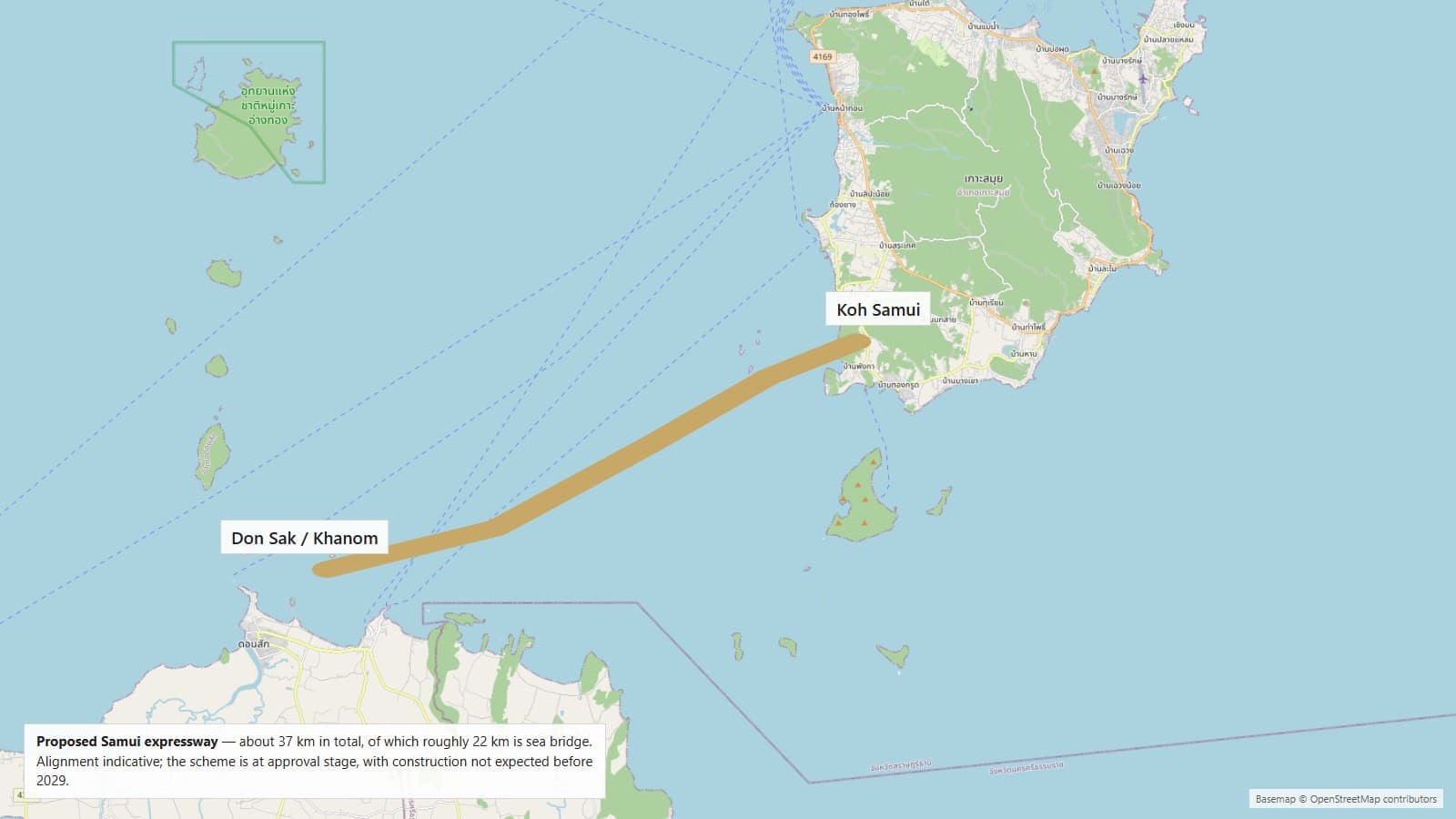
Image: Sasipimon Estate — Basemap © OpenStreetMap contributors
There is a serious plan to connect Koh Samui to the mainland by road. The Expressway Authority of Thailand has completed its feasibility study for a 37.41-kilometre route including a 22-kilometre sea bridge, and held its third public hearing on Samui in February 2026. What there is not, as of today, is cabinet approval, a construction contract, or a single pile in the water.
That distinction matters, because the bridge is routinely sold to buyers as though it were imminent. It is not. On the current published timetable, cabinet approval is sought in 2027, construction begins in 2029, and the road opens around 2033. A buyer signing a contract today is roughly seven years from driving across it — if every stage holds.
What the project actually is
The scheme is a four-lane expressway running from Highway 4142 in Don Sak district, through Khanom in Nakhon Si Thammarat, and onto Highway 4170 on Samui. The centrepiece is a cable-stayed sea bridge of about 22 kilometres with a clearance of at least 50 metres so large vessels can pass beneath.
Cost estimates reported publicly have moved between roughly ฿55 billion and ฿74 billion as the study has progressed, which is itself informative: the number is not settled. Separately, a private consortium has been reported as interested in a concession, with an auction discussed for 2028.
Why the stage matters more than the headline
Thai megaprojects have a long history of being announced, studied, re-studied and shelved. This particular bridge has been proposed in various forms for decades. The current round is more advanced than previous ones — a completed feasibility study and formal public hearings are real progress — but the decisive moment is cabinet approval and a funding mechanism, and neither has happened.
There is also a substantive argument against the bridge on the island itself, and it is worth understanding if you are buying here. A fixed road link changes what Samui is. Part of what makes island property valuable is the friction of getting here: it filters the visitor mix towards longer, higher-spending stays. Remove the friction and you get day-trippers, coach tours and mainland commuters. Several local business groups have made exactly this argument in the hearings.
A bridge would raise land values along the ring road and change the kind of island those villas sit on. Both things are true at once.
What a buyer should do with this information
Treat the bridge as an option with no expiry date attached to your purchase, not as a value in your calculation. If a property only works because a bridge arrives in 2033, it does not work. If it works today, an eventual bridge is upside you did not pay for.
The contrast with the airport is instructive. Samui airport's expansion is privately funded by the company that owns the airport, has a published scope, and starts in 2026. That is a commitment. The bridge is a proposal at the approval stage. They are frequently mentioned in the same sentence by people selling property, and they are not remotely the same kind of fact.
- Cabinet approval: sought 2027, not yet granted
- Construction start: 2029 on current plans
- Opening: around 2033, with completion reported as late as 2034
- Cost: reported between ฿55bn and ฿74bn, not final
- Status today: feasibility study complete, public hearings held
What would actually change if it were built
The economic case put forward for the scheme is large — figures in the region of ฿400 billion of forecast economic benefit have been reported — and the logic is not hard to follow. Everything on Samui arrives by boat, and that shows up in the price of building materials, groceries, vehicles and furniture. A road link would compress those costs and remove the logistical premium that sits on every construction project on the island, including ours.
It would also change the labour market. Construction and hospitality staffing on Samui is constrained by the cost and inconvenience of getting workers on and off the island, and a fixed link would widen the catchment to the mainland districts of Don Sak and Khanom. For a developer that is straightforwardly good news. For a landowner it is more complicated, because cheaper construction means more construction.
The counter-effect is the one to hold in mind if you are buying to let. Samui's rental economics rest on a visitor who has already committed time and money to reach a place that is hard to reach. Guests who fly to an island for a week behave differently from guests who can drive over for a night, and the accommodation that serves each is not the same product. A bridge would not destroy the villa market, but it would broaden the visitor mix downwards, and the properties most insulated from that are the ones people travel specifically for.
How to read the next two years
There are three signals worth watching, and they are all public. The first is cabinet approval, expected to be sought in 2027 — until that happens, nothing else matters. The second is the funding mechanism: whether this proceeds as a state project, a public-private partnership or a concession auction determines how quickly it can move and how firm the timeline becomes. The third is the environmental impact assessment, which for a 22-kilometre marine structure in the Gulf of Thailand is not a formality.
If all three land cleanly, 2029 construction is credible. If any one of them slips — and Thai infrastructure of this scale has a consistent record of slipping — the whole schedule moves with it. That is not cynicism, it is the base rate.
- Is the Koh Samui bridge under construction?
- No. As of 2026 the feasibility study is complete and public hearings have been held. Construction is not expected to begin before 2029.
- When will the Koh Samui bridge open?
- Current plans indicate around 2033, with some reports saying 2034. That assumes cabinet approval in 2027 and no slippage, which would be unusual for a project of this size.
- How long is the Samui bridge?
- The full expressway route is 37.41 kilometres, of which roughly 22 kilometres is sea bridge, with at least 50 metres of clearance for shipping.
- Will the bridge increase property prices on Koh Samui?
- Probably, over time, particularly near the ring road. But it is seven or more years away and not yet approved, so it should not form part of the case for buying today.
- Is everyone on Samui in favour of the bridge?
- No. A recurring objection is that easy road access changes the visitor profile towards day-trippers and reduces what makes the island distinctive.
The short version
The bridge is real, it is progressing, and it is early. Anyone presenting it as a reason to buy now is either not reading the timeline or hoping you will not. We build in Maenam on the north coast, and our view is straightforward: buy for the island as it is today, and treat 2033 as a possibility rather than a plan.
Sources
- 74-billion-baht Samui sea bridge set for 2029, 400 billion baht economic boost forecast — Khaosod English
- EXAT to seek Cabinet's approval for 55bn Samui bridge late next year — The Nation Thailand
- 37.41km Koh Samui to mainland bridge plan set for 2029 construction start — Thailand Construction and Engineering News